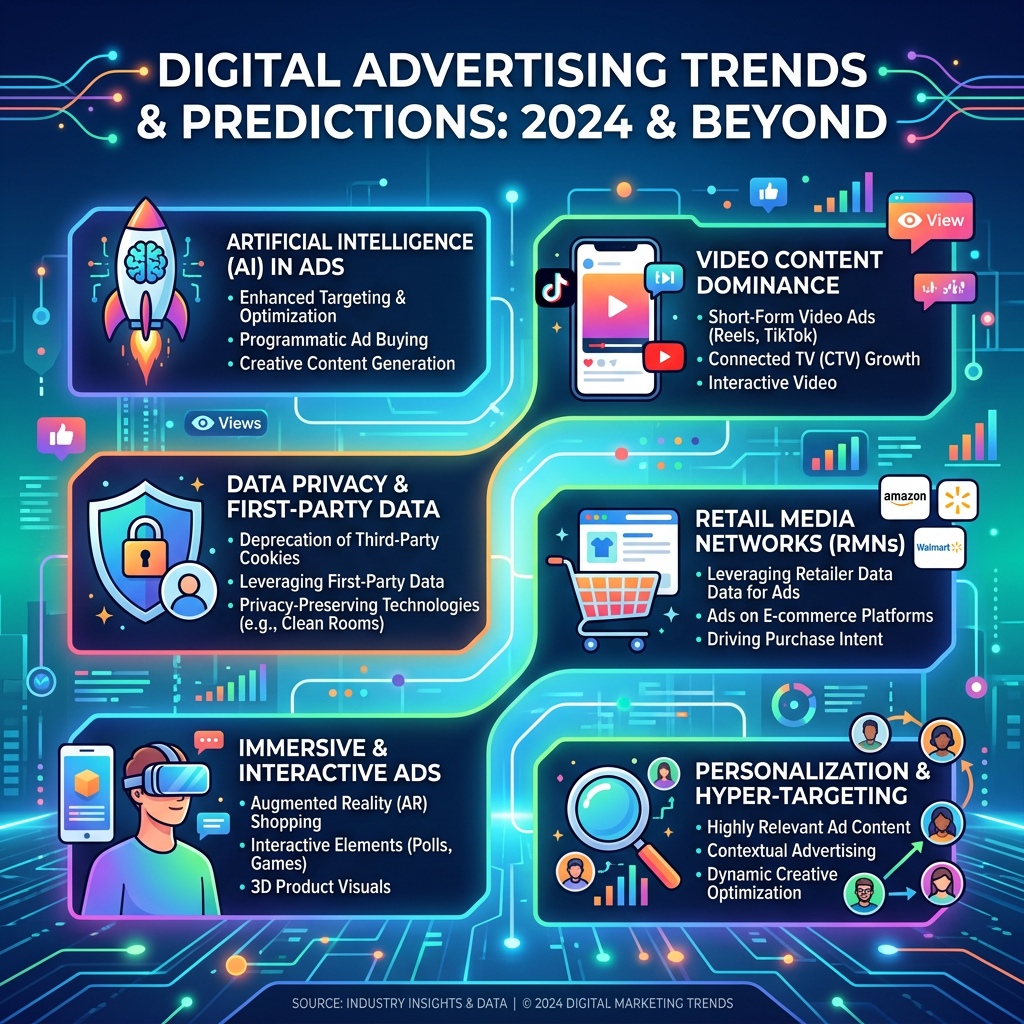
Digital advertising continues to evolve as technology changes how consumers interact with brands online. Over the next five years, three developments are expected to have the greatest impact on the advertising industry: artificial intelligence (AI), Google Ads and advanced search advertising, and influencer and user-generated content (UGC). These trends will help marketers create more personalized experiences, improve campaign performance, and build stronger relationships with consumers.
1. Artificial Intelligence (AI) in Advertising
Artificial intelligence is rapidly transforming digital advertising by helping marketers automate tasks, analyze large amounts of data, and deliver highly personalized content. AI-powered tools can predict customer behavior, optimize ad placements, and generate advertising content in a fraction of the time required by traditional methods.
One example is Google’s AI-powered Performance Max campaigns, which use machine learning to optimize ads across multiple platforms. According to Google (n.d.), AI can help advertisers improve conversions by automatically identifying the best audiences, placements, and bidding strategies. Additionally, a report by McKinsey & Company found that organizations using AI in marketing often experience increased customer engagement and improved return on investment (McKinsey & Company, 2023).
As AI technology becomes more advanced, advertisers will be able to create more relevant and personalized experiences for consumers, making campaigns more effective and efficient.
2. Google Ads and Advanced Search Advertising
Search advertising will continue to play a major role in digital marketing because it reaches consumers at the exact moment they are searching for information or products. Google Ads allows businesses to target users based on keywords, demographics, location, and online behavior.
Google reports that advertisers can use detailed analytics and conversion tracking to measure campaign performance and make data-driven decisions (Google, n.d.). Additionally, search advertising often reaches consumers with high purchase intent because users are actively searching for solutions to their needs. This makes Google Ads one of the most effective tools for driving website traffic and conversions.
In the future, search advertising is expected to become even more sophisticated through AI-driven automation, predictive targeting, and improved audience segmentation. These advancements will help businesses deliver more relevant advertisements while maximizing advertising budgets.
3. Influencer Marketing and User-Generated Content
Consumers increasingly trust recommendations from real people more than traditional advertisements. As a result, influencer marketing and user-generated content (UGC) are expected to continue growing over the next five years.
According to HubSpot (2024), consumers are more likely to trust content created by other consumers because it feels authentic and relatable. User-generated content often produces higher engagement rates than brand-created content. Similarly, influencer partnerships allow brands to connect with highly targeted audiences through trusted content creators.
Platforms such as TikTok, Instagram, and YouTube have made influencer marketing an essential part of many advertising campaigns. As social media continues to evolve, brands will increasingly rely on creators and customer-generated content to build credibility, encourage engagement, and drive purchasing decisions.
Artificial intelligence, advanced search advertising through Google Ads, and influencer marketing with user-generated content are likely to have the greatest impact on digital advertising over the next five years. These developments will help marketers create more personalized experiences, improve campaign performance, and strengthen consumer trust. Businesses that embrace these technologies and strategies will be better positioned to compete in an increasingly digital marketplace.
References
Google. (n.d.). About Google Ads. https://ads.google.com
Google. (n.d.). Google Ads Help Center. https://support.google.com/google-ads
HubSpot. (2024). State of marketing report 2024. https://www.hubspot.com
McKinsey & Company. (2023). The state of AI in 2023: Generative AI’s breakout year. https://www.mckinsey.com


Leave a Reply